Real-Time Computer Vision for Poker Game-State Capture
Xabier, poker technology project
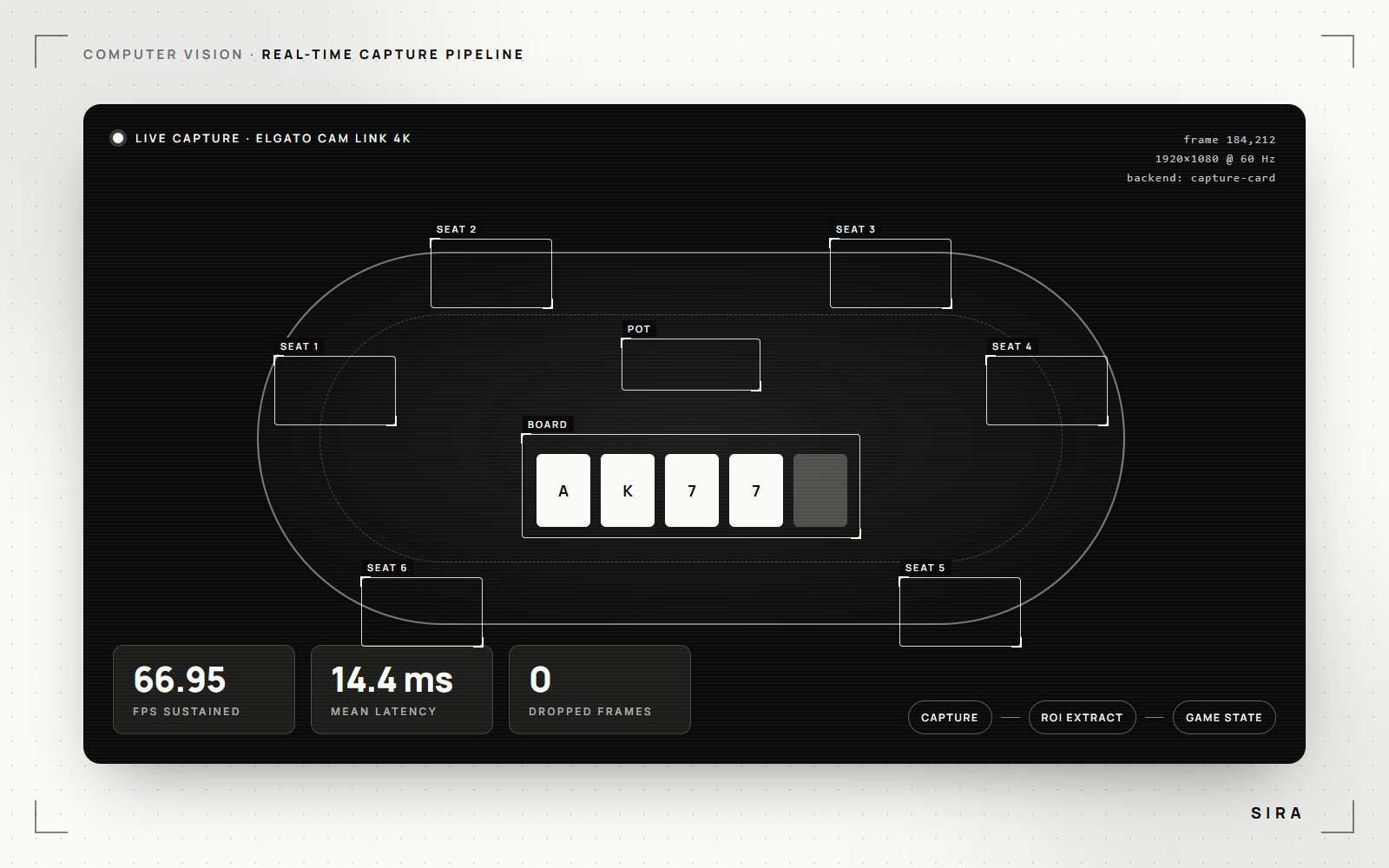
Built the capture pipeline and region-of-interest framework for a real-time poker vision engine: 67 FPS capture at 14 ms mean latency on a compact Intel NUC, with zero dropped frames.
The Challenge
Xabier needed a system that reads the state of a live poker table from a video feed in real time, on small, affordable hardware. Late or missed frames mean missed actions, so the pipeline had to sustain 60 FPS with low latency, recover from capture-device disconnects on its own, and be testable without the physical hardware attached.
Our Solution
We built the foundation in Python and OpenCV around a hardware-agnostic capture interface with four interchangeable backends: an Elgato Cam Link 4K capture card, two screen-capture fallbacks (DXcam and MSS), and video-file playback so development and testing don't depend on the hardware. On top of that sits a region-of-interest framework: table regions are defined in YAML, adjusted in a visual calibration tool, and support multi-seat elements such as the dealer button. A benchmark suite measures FPS, per-frame latency, long-run stability and reconnection, and generates a report for each milestone.
Results
In milestone benchmarks the pipeline sustained 66.95 FPS against a 60 FPS target, with 14.4 ms mean capture latency (target under 30 ms), zero dropped frames, and automatic reconnection in 1.5 seconds on average, all on an Intel NUC i5-8259U. The configurable ROI framework and video-based test harness give the next milestone, game-state recognition, a stable and measurable base.
Have a similar problem?
Talk it through on a free 30-minute call, or send a short note first.