03 · Automation
AI document processing and business process automation
Intelligent automation that reduces manual work, improves accuracy, and scales your operations.
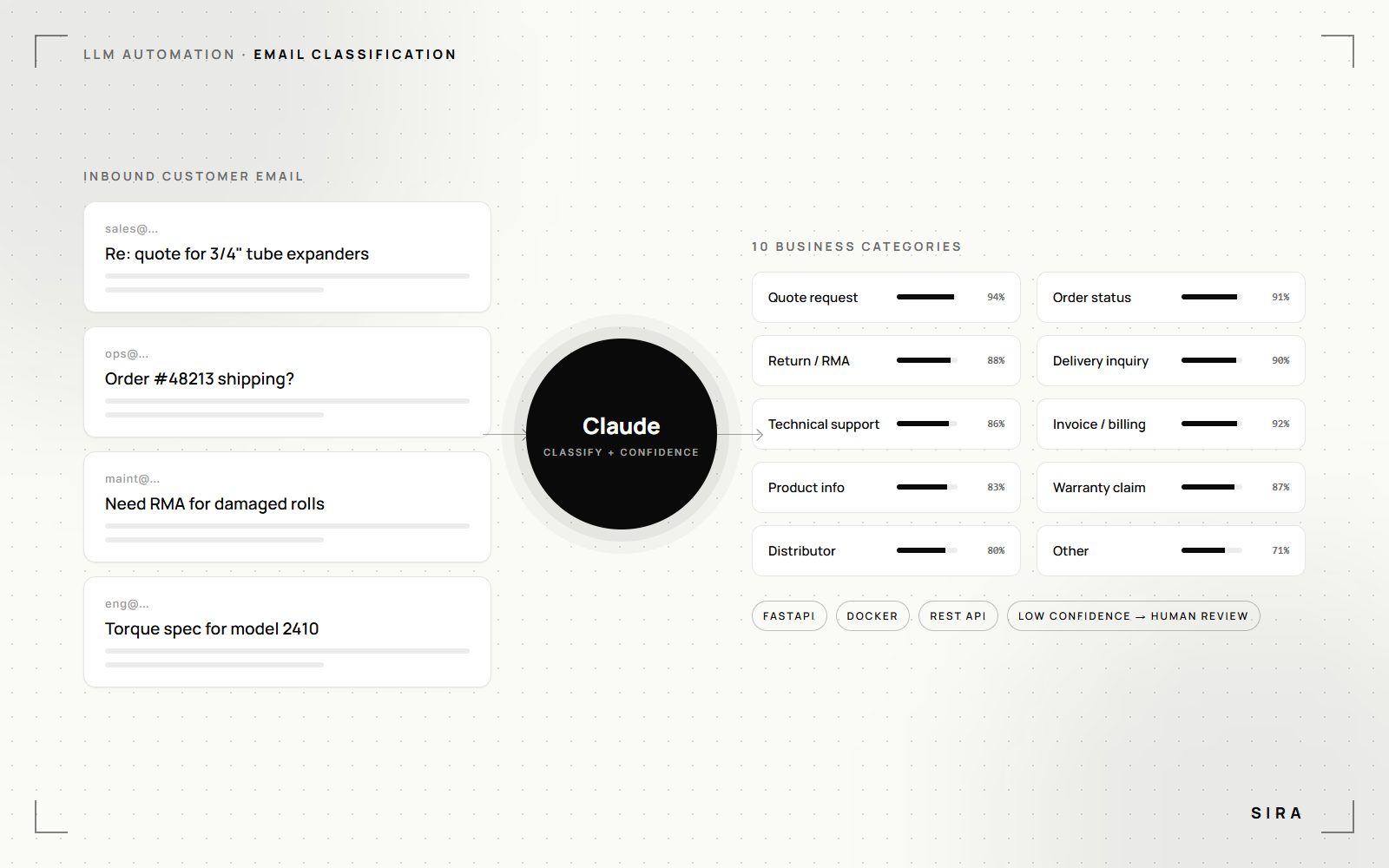
Every business runs on repetitive processes — moving data between systems, extracting fields from documents, generating the same reports every week. Traditional automation handles the rigid parts but breaks on anything that requires judgment. AI process automation closes that gap, handling the ambiguous, unstructured work that used to demand a person.
Automating the Judgment, Not Just the Clicks
Rule-based automation is excellent when inputs are perfectly structured and predictable. Real business processes rarely are. Invoices arrive in a hundred layouts, emails vary in wording, forms come in half-completed. The moment a process needs to interpret rather than merely transfer, classic automation stalls and a human has to step back in.
AI-powered automation is built for exactly that ambiguity. It reads a document it has never seen in a new format, understands an email's intent, and decides where a request should go. This is what lets you automate the messy middle of a process — the part that consumed the most human time precisely because it required interpretation.
Confidence, Validation, and Human Review
Automating judgment safely requires knowing when the system is unsure. Every automated decision we build carries a calibrated confidence score, and business rules validate the output before it flows downstream. High-confidence results are processed automatically; anything uncertain routes to a person for a quick check.
This design captures most of the savings immediately while keeping a human safety net where errors are most likely. As the system proves itself on your real workload, you raise the automation threshold and expand its reach — a dial you control, not an all-or-nothing switch you flip and hope for the best.
Integrated With the Systems You Already Run
Automation that lives in a silo just moves the manual work somewhere else. We integrate directly with your existing tools — your ERP, CRM, ticketing system, and databases — so data flows end to end without a person copying it between screens. The automation fits your operation rather than forcing you to rebuild around it.
Typical applications include workflow automation, intelligent document processing, data extraction and validation, automated reporting, and integration between systems that never spoke to each other. The impact is direct: processing time drops from minutes to seconds, error rates fall, and your team shifts from data entry to the higher-value work only people can do.
Frequently asked questions
What is AI document processing?
Software that reads invoices, forms, contracts and emails in whatever layout they arrive, extracts the fields you need, and validates them before they reach your ERP, CRM or spreadsheet.
How is this different from traditional automation or RPA?
Rule-based automation breaks when inputs vary. AI automation handles the ambiguous parts, such as a new invoice layout or an email's intent, and routes anything uncertain to a person.
Is AI automation worth it for a small business?
It is when a repetitive task eats hours every week, such as data entry, inbox sorting or weekly reports. We start with one workflow, measure the time saved, and expand from there.
Which systems can it connect to?
Most tools with an API or export, including ERPs, CRMs, ticketing systems, email, Google Workspace and databases.
╱ Other services
Machine Learning Development
Custom ML models designed for your specific business challenges — from data analysis to production deployment.
Computer Vision Solutions
Visual AI systems that see, understand, and analyze images and video for automation and insight.
AI Integration & Agent Orchestration
Coordinated AI agent systems that handle complex, end-to-end workflows — giving lean teams enterprise-grade operational power.